Careers

Welcome to the ultimate career information hub for students, parents, employers, and teachers! Here, you'll discover valuable links and information on not just careers at Lift Tamworth, but more importantly, the vast array of opportunities available in the world of work. Let's unlock your potential and explore the exciting possibilities together!

Mrs C Carpenter

Our careers Strategic lead and Vice principal Contact details: ccarpenter@lifttamworth.org Tel:01827 285596

Other members of the team include:

The importance of CEIAG at Tamworth

At Tamworth, we understand that finding your dream career can be daunting, but we've got your back! Our comprehensive program ensures that every student leaves with the tools and knowledge they need to succeed, including:

  •  Identifying your strengths and weaknesses.
  •  Accessing the latest resources to research suitable careers.
  •  Expert guidance on interpreting career information.
  • One-on-one support to explore career ideas and boost confidence.
  •  Ongoing sessions to enhance vital skills like CV writing and interview techniques.

The Careers Programme

Get ready to supercharge your child's career journey with our cutting-edge Careers Programme!

We've poured our hearts and souls into designing a comprehensive roadmap to support your child's progress, from their early career stages to beyond. With our programme, you and your child will gain access to top-notch guidance, immersive employer experiences, and timely information that will set them up for success.

We believe that every student should be fully prepared for the challenges and rewards of adult life, and we're committed to making this a key part of our curriculum.

But we don't stop there - we're constantly on the lookout for exciting opportunities to enrich our programme, partnering with local employers and training providers to provide practical, skills-based activities that'll take your child's career prospects to the next level.

Get ready to embark on a journey of discovery and growth with our unbeatable Careers Programme!

Year 7: Widening Horizons:Introduction to Careers.Encourage high aspirations and develop confidence

Year 8: Understanding opportunities in the developing labour market

Year 9: Introduce higher education and start to map out pathways to their future careers.

Self-assessment – Produce a career action plan ahead of options decisions

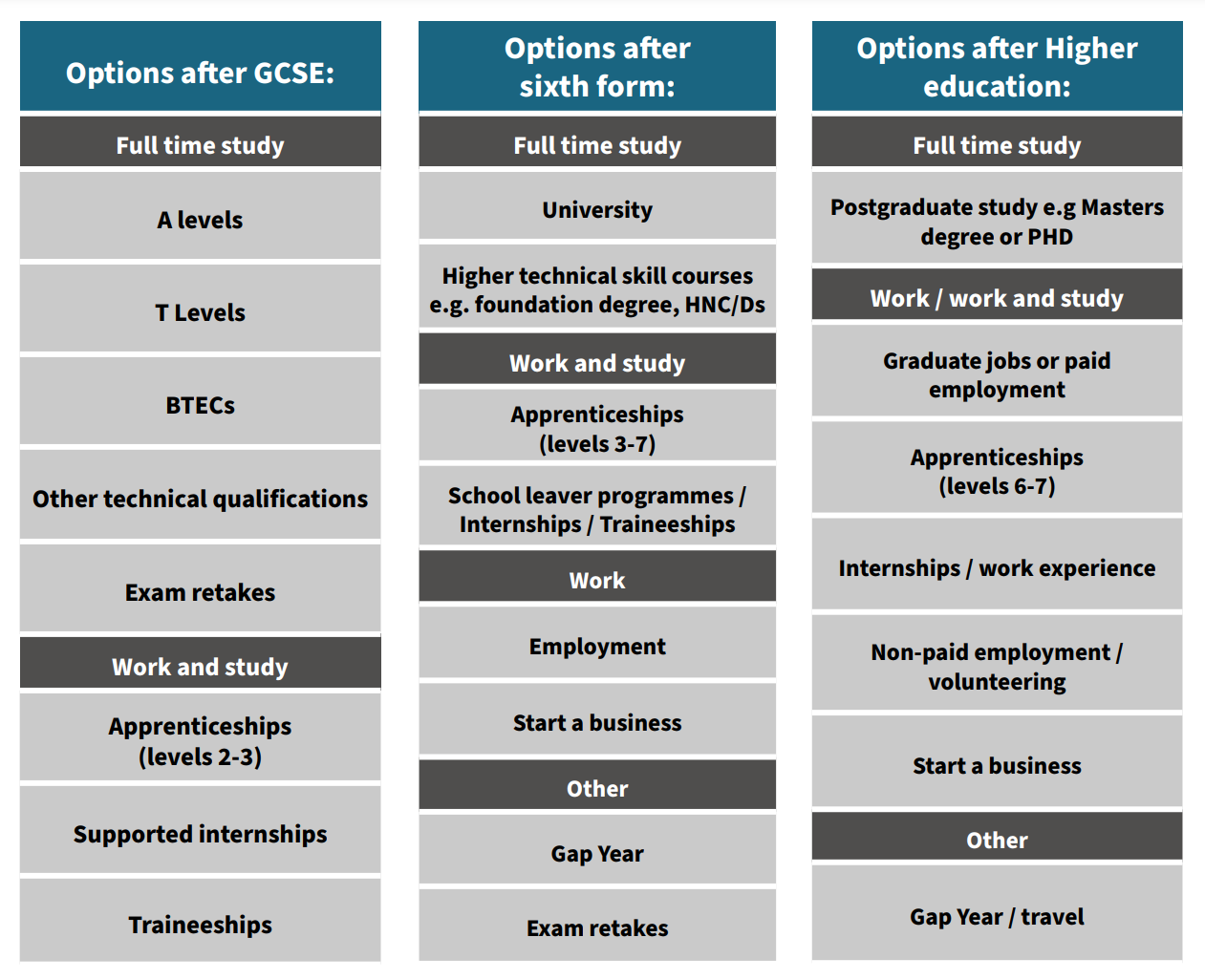
Year 10: Build knowledge and experience of different types of options for post-16 and post-18 study and career opportunities.

Year 11: Widening advice on options, including apprenticeships, entrepreneurialism or other vocational routes alongside A-level and University

Resources to support provision

  • Access to a range of careers providers to deliver specific sessions and assemblies to the students.
  • Access to a Careers Hub to share good practice and allow easy access to local businesses.
  • The Compass Plus tool to track against the Gatsby Benchmarks.
  • Regular contact with an Enterprise Co-ordinator and Enterprise Advisor from the local Career Hub.
  • Access to the most up to date Careers Lead training and accreditation.

Careers in the Curriculum

We believe that every subject can offer unique insights into the world of work, which is why we've developed dedicated careers programmes across all subject areas. Our lessons are designed to showcase the exciting range of careers related to each subject and how they connect to real-world skills and opportunities. You'll find relevant careers information displayed within each department, and our teachers often invite professionals to share their insights and experiences with our students. Whether you're exploring a passion or considering a new career path, our subject-specific careers talks are a great way to gain invaluable knowledge and inspiration.

Evaluation

At our school, we're committed to continuously improving our CEIAG provision, which is why we regularly seek feedback from all stakeholders including students, staff, parents, and volunteers. We take all feedback seriously and use it to enhance our programmes for future year groups. We ensure that every activity is evaluated by both students and staff, and we seek feedback from parents and volunteers whenever appropriate. Our aim is to create a dynamic and responsive CEIAG provision that meets the needs and aspirations of all our students.

Work Experience

Every Year 10 student participates in a 5-day work experience in July. The students themselves find and arrange the placements, which aims to develop their skills in job search. We thoroughly check all placements for health and safety. Work experience is a valuable opportunity for students to gain confidence, maturity, and insight into the skills needed in the workplace.

Tamworth is committed to providing our students with a comprehensive programme of Careers, Education, Information, Advice and Guidance (CEIAG). It is vital that we make sure our students are able to receive the guidance they need to make sensible choices as the move through each stage of their education and onto their chosen career.

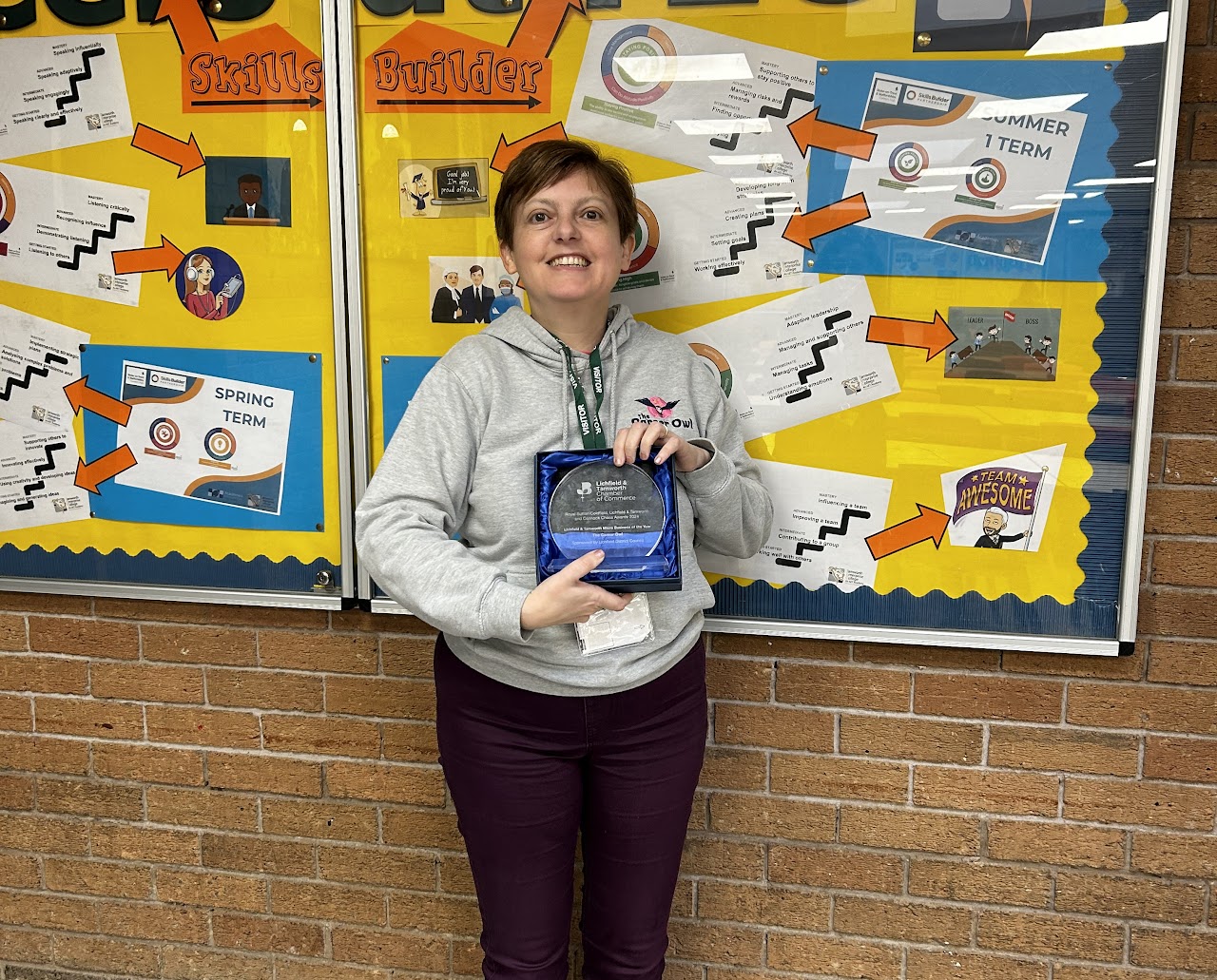
CONGRATULATIONS!!

Kathryn Hall, Lift Tamworth Enterprise Advisor

2024 Winner of the "Lichfield and Tamworth Micro Business of the Year" category at the Royal Sutton Coldfield, Lichfield, Tamworth and Cannock Chase Chamber of Commerce Awards

Winner of Best Employability Support Services 2023 - Staffordshire

Nominations

Nominated in the Small Business of the Year category in the Staffordshire University Business Awards 2023 and for a Woman Who Achieves Solopreneur Award 2023

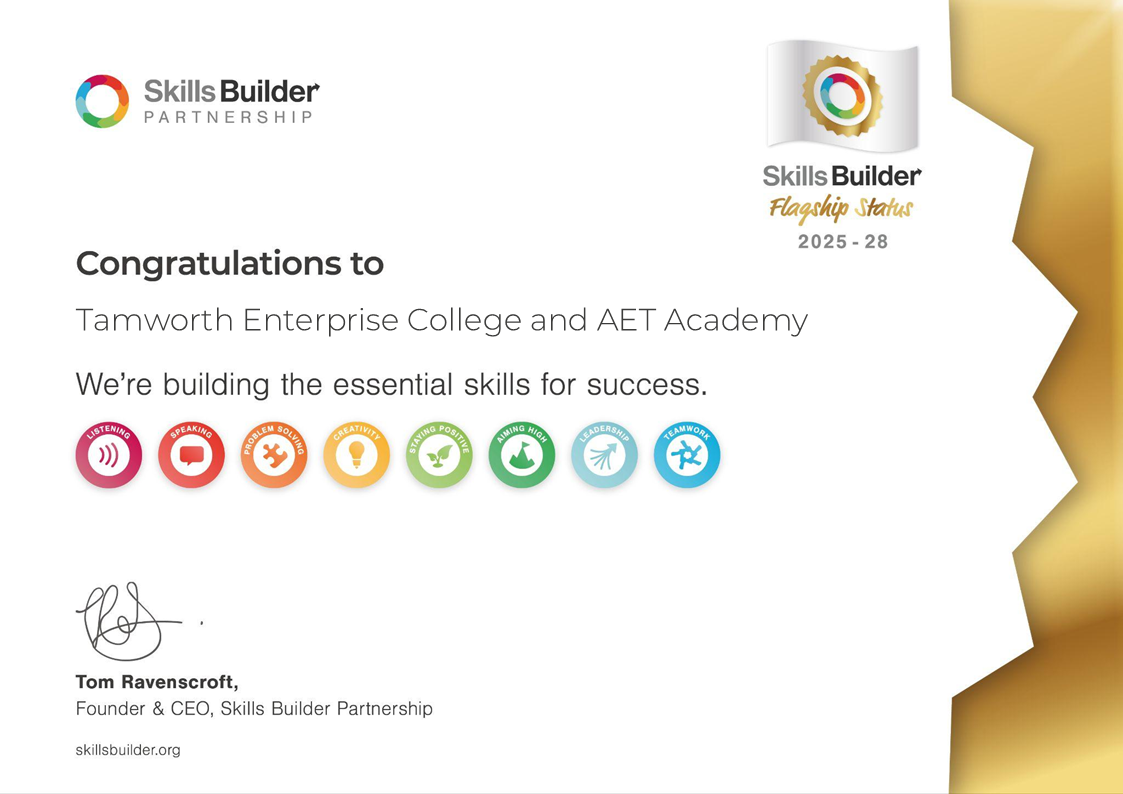
We are a Skills Builder Provider school. It is the imperative for students to articulate and demonstrate specific skills essential for the workforce is underscored by Tamworth's pioneering collaboration with the Skills Builder Partnership. Through a pilot project seamlessly integrating the Skills Builder toolkit with key competencies identified by employers in the Stoke and Staffordshire Careers Hub, the initiative, launched in September 2023, has been successfully woven into the fabric of the institution. Visible logos, tracking information in planners, and alignment with the school's behaviour framework collectively reinforce the commitment to preparing students across all year groups for a successful transition into the dynamic world of work. Progress and enhancements will be systematically monitored through the Behaviour Framework, complemented by the comprehensive insights gathered from the completion of the Future Skills Questionnaire.

Skills Builder
What are the Pathways?

At Tamworth our students must follow one of the pathways explained below, which will include:

  • English.
  • Film Studies (Visual English).
  • Maths.
  • Science.
  • Core Physical Education.

All students will study the subjects listed above as well as developing British Values, Social, Moral, Spiritual and Cultural aspects through a variety of topics within each subject area and through weekly House assemblies. Other opportunities for such development will come through enrichment activities after school.

‘EBacc’ Pathway:

We expect some students to follow the ‘EBacc’ pathway which involves studying Spanish, a Humanity (Geography or History) and one other GCSE subject. This will give the student a balanced foundation to move into higher education.

GCSE Pathway:

This is where most of our students will choose their options from. This pathway will consist of three subjects. We wold hope that one of these subjects would be either Geography or History. Students can select a BTEC subject from the list as this holds GCSE equivalence.

Foundation Pathway:

This pathway is tailored to those students who want to develop a broader set of skills which include allowing their creative and expressive qualities to come to fruition. Our SenCo Co-ordinator will discuss with specific parents and students who may benefit from such an opportunity.

No student is restricted to the pathway that they can follow, but we firmly believe that our guidance and support will allow you son/daughter to make an informed and appropriate decision about their future.

KS3 to KS4 GCSE Pathway Guide

Here at Tamworth, we aim to deliver a broad and balanced curriculum that will meet the needs of all our students and allow them to follow the appropriate pathway for the development into a future area of study and onto their chosen career.

We take the process of choosing options very seriously and our aim is that all students and their parents, should be provided with enough information to make informed choices about their future. The pathway guide (2018-2020) is the key source of information available to all, to assist in making the transition process run as smoothly as possible.  The school also holds an 'Options Evening' which would be beneficial for you to attend, as this will provide the opportunity to have the whole process explained in greater detail, enabling you to have empowered knowledge in supporting your son/daughter to make the correct choices.  

Personalised advice and guidance will be provided by Heads of House and Senior Leaders, so please do not hesitate to make contact with them as they are here to support you and provide guidance through the pathway process.

Once all option slips have been returned, checked and approved we will then start work on constructing the Key Stage 4 timetable for the next academic year. Occasionally, it may be necessary for some students to make alternative choices as some subject combinations may prove to be impossible e.g. some class sizes may be too small or because there is a clash with subjects being taught at the same time.

If this happens we will endeavour to explain the issues promptly and assist in providing additional support to select alternatives. It is fundamental that students take the time to discuss with teachers their choice of optional subjects. Once the student has then commenced the KS4 pathway there will be no option to change, so it is VITAL that all students choose their options carefully and discuss with staff the content of the courses on offer.

Please click on the link below, to access the Pathway guide:

Please click on links below, for the Option selection forms.  (Should you have difficulty in printing these forms, copies can be obtained from the School Office.)  These forms can be printed and returned manually.

CEIAG for Key Stage 4

Key Stage 4 is the legal term for the two years of school education which incorporate GCSEs, and other exams, in maintained schools in England normally known as Year 10 and Year 11, when pupils are aged between 14 and 16.

Tamworth will offer the following careers support and guidance for all students within KS4. They will all receive the following:

  • Consider undertaking a One week block work experience placement which focuses on students’ future career aspirations, where possible, allowing learning about work through the experience of work.
  • Careers Fair in school day.
  • College presentations.
  • Careers Interview for every Year 11 student.
  • Information on College ‘Open Days’.
  • Support when completing College Application forms.
  • Mock Interviews.
  • Supported CV and Personal Statement sessions within English curriculum.
  • Close monitoring of vulnerable students.

By the end of Key stage 4, all students will have:

  • Enhanced their self-knowledge, career management and employability skills.
  • Used ICT software and other sources of advice to investigate and explore future choices and progression routes.
  • Considered the value of gaining experience of the ‘World of Work’ through a placement if they require one (first 2 weeks in July).
  • Been given direct access to employers, colleges and training providers.
  • Been given guidance to help identify a range of post-16 options and careers advice.
  • Been provided with the resources to complete the post-16 application process, including CV’s, personal statements, and preparation for interview.
  • Been given information about appropriate available funding
  • Produced a challenging but realistic plan for their future learning and work, by relating their abilities, attributes and achievements to the goals they have set themselves.

CEIAG for Key Stage 3

Key Stage 3 (commonly abbreviated as KS3) is the legal term for the three years of schooling in maintained schools in England and Wales normally known as Year 7, Year 8 and Year 9, when pupils are aged between 11 and 14.

Tamworth will offer the following careers support and guidance for all students within KS3.  They will all receive the following:

  • Curriculum support in all subjects promoting related job advice.
  • Allotted time through ‘Tutor Time’ for self-development focusing on lifestyle and progression.
  • Access to the careers etc software during Tutor Time.
  • Year 9 will be invited to attend a Pre-Options Evening.
  • Assemblies and other information on KS4 options including vocational and alternative courses.
  • Enrichment and Enterprise activities take place on Curriculum days.

By the end of KS3 all students will have:

  • A better understanding of their strengths, achievements and weaknesses and support to evaluate how these might inform future choices in learning and work.
  • A better understanding of the full range of 14-19 opportunities for progression.
  • An understanding of some of the qualities, attitudes and skills needed for employability.
  • Used online careers resources to research information about opportunities and apply their findings to help make informed choices for Key Stage 4 options.
  • Received appropriate advice and guidance on Key Stage 4 options and prepared an individual learning plan that sets broad learning goals.

Qualifications and Assessments

What are GCSE's?

GCSE - stands for General Certificate of Secondary Education. GCSE examinations are taken by most pupils at the end of compulsory school education (year 11) in England, Wales and Northern Ireland.

GCSE's

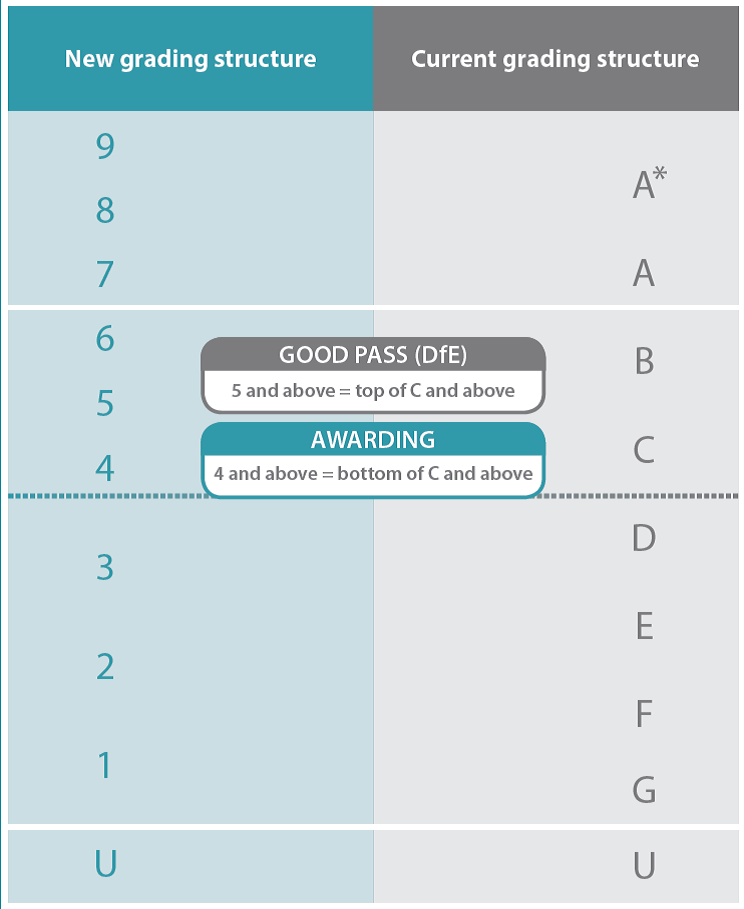
These are the main qualifications at Key Stage 4. They are graded A* to G in some subject areas, but the vast majority are now graded 1-9 as per the new GCSE grading structure, (more details under assessment changes).

The expectation is that any student working at grade 4-5 in a subject in Year 9 should go on to gain a grade C equivalent in the subject at GCSE. GCSEs are assessed by externally set written examinations and controlled internal assessments.

Level 2 BTEC Award and Extended Certificates.

These are courses linked to vocational areas. They have practical based elements and most marks come from a portfolio of coursework and assignments, which assess how well the student can demonstrate the skills and understanding that they have developed. These are currently awarded at one of the following grades, Distinction *, Distinction, Merit and Pass, and have a GCSE equivalence.

TLM Information Technology and Computing Awards.

These are computing or IT qualifications that are assessed through a portfolio of work to demonstrate what you can do to pass the qualification. There Is an external exam for the level 2 course.

Assessment changes.

Over the next few years, new, tougher GCSEs will be introduced; firstly in English and Maths, then in most other subjects the following year. This is the same for all schools in the country. The new GCSEs will be graded on a scale from 9 - 1.

The new system does not mirror the old letter grade system of the current GCSEs. However, the new grade 4 is in-line with the current grade C, and the new grade 7 is in-line with the current grade A. It is expected that the new grade 9 will be awarded to the top 20% of students who presently achieve grades A and A* in current GCSEs.

The table below compares the current and the new GCSE grading structure.

Where students are studying towards the current GCSEs, we will be reporting to parents using the old A* - G grades. For subjects that will be new GCSEs, we will report using the new 9-1 grades. Many of our students will continue to take BTEC qualifications as well as GCSE ones; these are graded at Level 1 Pass, then at Level 2: Pass, Merit, Distinction and Distinction*. The Level 2 Pass is equivalent to achieving a grade C under the current GCSE system.

BTEC Construction

How do I know this subject is for me?

The rationale for all qualifications in the BTEC First suite in Construction and the Built Environment is to:

  • Inspire and enthuse students to consider a career in the construction sector.
  • Give students the opportunity to gain a broad knowledge and understanding of, and develop skills in, the construction industry.
  • Support progression to a more specialised level 3 vocational or academic construction course or an apprenticeship.
  • Give students the potential opportunity, in due course, to enter employment within a wide range of junior job roles across the construction industry.

What is a BTEC?

BTEC stands for ‘Business and Technology Education Council’, named after the body which first governed the qualifications (it’s now Edexcel). BTECs are gaining popularity as an alternative to A-Levels, but they actually cover a whole range of academic levels. BTECs at levels 1 and 2 are equivalent to GCSEs, level 3 to A-Levels, and levels 4 -7 hold the same status of achievement as a degree.

BTECs are vocational qualifications, rather than traditional academic courses, with typical subjects offered at BTEC level including Business Studies, Travel and Tourism, Engineering and Information Technology – you can’t study subjects like History or English at BTEC level.

What will I learn?

Unit 1: Construction Technology - this unit covers the different forms of construction that can be used for low-rise offices, retail units and homes. Students will develop an understanding of the structural performance required for low-rise construction, and explore how substructures and superstructures are constructed. This unit will be externally assessed.

Unit 2: Construction and Design - in this unit students will develop a broad understanding of the construction industry, the sort of projects it undertakes and the contribution it makes to wider society. Students will also look at how client needs can shape the design of a building, and develop their own design ideas to a given brief.

The mandatory unit is:

Unit 3: Scientific and Mathematical Applications for Construction - in this unit students will apply scientific and mathematical knowledge, understanding and skills to practical construction contexts. Students will develop an understanding of the scientific principles affecting the performance of construction materials and develop skills to perform mathematical calculations in construction contexts.

Unit 6: Exploring Carpentry and Joinery Principles and Techniques - In this unit students will understand tools, materials and equipment used in carpentry and joinery and then develop practical skills using safe techniques to produce a timber frame.

How will I be assessed?

The Edexcel BTEC Level 1/Level 2 First Award in Construction and the Built.

Environment is taught over 120 guided learning hours (GLH). It has core, mandatory and optional specialist units. Students must complete the two core units, the mandatory unit plus one of optional specialist units to reach a total of 120 GLH. This BTEC First Award has units that are assessed in school (internal) and a unit that Edexcel sets and marks (external).

The Grading for the course and its GCSE equivalency is as follows:

BTEC Level 1 pass (GCSE D)

BTEC Level 2 pass (GCSE C)

BTEC Merit (GCSE B)

BTEC Distinction (GCSE A-A*)

If you have any queries regarding this option, please contact:

Teacher in charge: TBC

Email: TBC

Exam board: Edexcel

Website: http://qualifications.pearson.com/en/qualifications/btec-nationals.html

No items found.
Employers

Engage with schools and colleges in your local community by sharing your career journey and industry knowledge to help young people consider their career options. As someone who owns or works for an organisation, your unique experience can make a difference in shaping the future leaders in your community. If you are interested in supporting our students please email  C Carpenter or A Bibi  in the first instance.

There are different ways to get involved:

Option 1: Volunteer for an hour or more by delivering career activities or hosting a workplace experience in local schools and colleges. This is a great way to give back to your community and potentially find new recruits for your business. You can speak to a class about your sector, participate in a business competition, carry out a mock interview, or support a CV workshop. These short activities can create new perspectives and inspire new ideas that can change a young person's life.

Option 2: Become an Enterprise Adviser by partnering with a secondary school or college to help them develop a strong careers program. As a manager or above, you can use your business experience and networks to make a significant impact.

Option 3: Provide ongoing support as a Cornerstone Employer by working with a cluster of secondary schools and colleges to strategically support careers provision in an area. Your whole organisation can get involved in this effort.

By engaging with schools and colleges, you can link careers to curriculum, bring subjects to life, and give top tips for CVs and interviews. You can also support entrepreneurial skills by offering advice or acting as a judge in school competitions. Additionally, you can allow visits from students for a day to see the different roles in your workplace or offer work experience placements. By doing any of these activities, you show young people your industry and the skills required, which can help them understand how what they learn at school can be applied in a real-life work environment.

If you are interested in working in partnership with us or keen to offer opportunities to our students or school, please contact: C Carpenter or A Bibi

Please see below some links you might find useful

Labour Market Information (LMI)

What is meant by the term  'Labour Market'?

The labour market, also known as the job market, refers to the supply of and demand for labour, in which employees provide the supply and employers provide the demand. It is a major component of any economy and is intricately linked to markets for capital, goods, and services.

Why do I need to know about the Labour Market?

Labour market information can help you make a good decision when you are exploring a career path, want to change jobs or move to a new place. It can help you find out what the labour market is like for that job or that city. For example, if you were interested in becoming a nurse or doctor and you move to a town where there is not a local hospital, you will have a hard time finding a job.

Labour market information tells you:

  • What jobs and skills employers are looking for.
  • Which industries are hiring and where they are located.
  • Where to find employers who are hiring.
  • What education and training you need for specific jobs.
  • Which job areas are growing in the future and other statistics.

Want to know more about the Labour Market?

Here are a list of useful links you can read around regarding the Labour Market:

Let's Talk Futures

Welcome to Lift's ‘Let’s Talk Futures’  - a one stop shop for parents / carers looking to support their children as they make important decisions about their future pathways.

As parents, carers and guardians, you are the biggest influencer of your young person's decisions about their next steps, their qualification choices, their place of study and ultimately their career choice. As parents it is not always easy to know where to find the latest information, what questions to ask or what advice to give. Hopefully this website, the supporting guides, resources and signposting to useful links will help you to support your child to make informed decisions and turn their aspirations into reality.

Do Together Tasks - click on the image below to access

We have created a series of short tasks and activities that you might like to use with your child when discussing careers at home. The resource is designed to help you instigate purposeful career conversations and includes things like key questions you might like to ask, discussion prompts you can use, short activities that you can set and links to resources and websites that you can explore together.

Lets talk futures KS3

‘Thinking about the future’

A short and informal live webinar session for KS3 parents and their children. The session will be in the format of a panel discussion and will include experts such as careers advisers and recruitment specialists. You will have opportunities to submit questions during the session via the chat facility and panellists will do their best to respond to these. The discussion will cover the skills employers look for, the jobs market of tomorrow, the range of progression routes available and considerations when choosing KS4 options. The webinar will be recorded and posted on this page so that you can watch it back should you wish to.

Please fill in the form below to register and you will be sent a link to join the event.

Lets talk futures KS4

‘Preparing for Post 16 Pathways’

A webinar for KS4 parents and their children: The webinar will cover qualifications, progression routes and ‘choosing the right pathway for me’. This will be targeted at Y10 and Y11 parents.

Please fill in the form below to register and you will be sent a link to join the event.

Lets talk futures
More Information
News and events
More
Introducing a new look for our school
Details
Newsletter - 1 September 2025
Details
Newsletter - 11 July 2025
Details
Accreditations